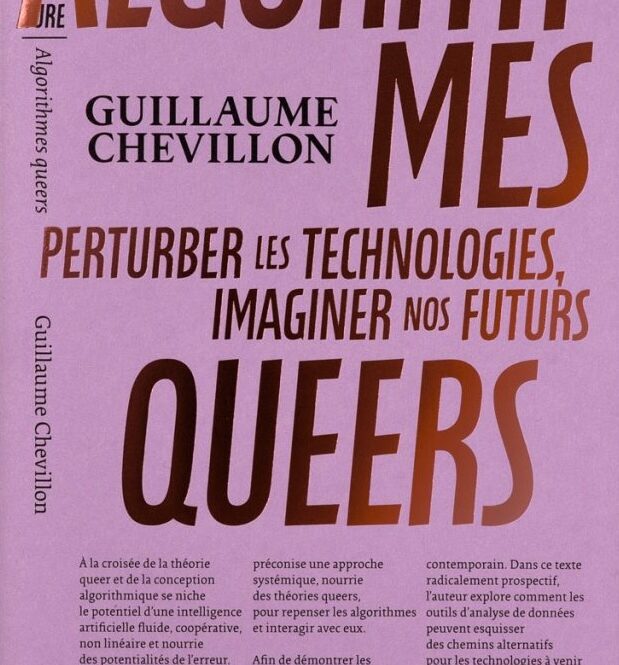
WED 4 NOV 2026— 4.00pm Lecture organised as part of the teaching programme, open to the public. Guillaume Chevillon is a professor at ESSEC, where he holds the Chair in Cultural Industries, Art and Creative Technologies and is Director of Metalab for AI, Data and Society, a transdisciplinary research institute dedicated to the societal challenges of artificial intelligence.
Algorithms anticipate our tastes, our decisions and our futures, and in doing so influence them. Optimised for immediate performance, they tend to trap our societies in futures we do not choose: recommendations that homogenise our imaginations, self-fulfilling predictions, and categories that freeze identities in place. What if queer theory offered an alternative?
In *Queer Algorithms* (Éditions B42, 2026), Guillaume Chevillon demonstrates that the characteristics long cultivated by minority experiences – tolerance of error, the right to be forgotten, an appreciation of chance, a rejection of rigid categories, and a deliberate obscurity – paradoxically constitute what makes algorithmic systems more robust, more sustainable and more respectful of the diversity of human experiences. Error is no longer a flaw to be eliminated, but a potential driver of prediction.
For there is no need to design or own the algorithms in order to influence them. Refusing to cooperate or respond to their prompts, playing with memory and prioritising forgetting to break free from the determinism of recommendations, cultivating chance and experimentation, building communities and coalitions that strengthen our capacity for action, testing the limits of the systems to break free from the categories they impose on us: these are all practices, stemming from the experiences of marginalised groups, which enable everyone to stand up to algorithms.
Biography
Guillaume Chevillon is a professor at ESSEC, where he holds the Chair in Cultural Industries, Art and Creative Technologies and is Director of Metalab for AI, Data and Society, a transdisciplinary research institute dedicated to the societal challenges of artificial intelligence. An economist specialising in econometrics and forecasting methods, he studies dynamic phenomena in economics and the interactions between machine learning and human behaviour. He is developing a transdisciplinary approach to contemporary technological challenges.
WED 25 NOV 2026— 4.00pm A talk organised in partnership with CEAC/University of Lille as part of the educational programme, open to the public. Matthieu Raffard has been working as part of an artist duo with Mathilde Roussel since 2017.
WED 18 NOV 2026— 4.00pm A lecture organised as part of the educational programme, open to the public. Cy Lecerf Maulpoix is an author, translator and lecturer in critical theory at the city’s School of Fine Arts (INSEAMM).
WED 28 OCT 2026— 4.00pm A talk organised as part of the educational programme, open to the public. Florent Maurin is a graduate of the Lille School of Journalism.